
Great Power, Great Responsibility: How the Liberal International Order Shapes US Foreign Policy
By Michael Poznansky
Review by Lucas F. Schleusener
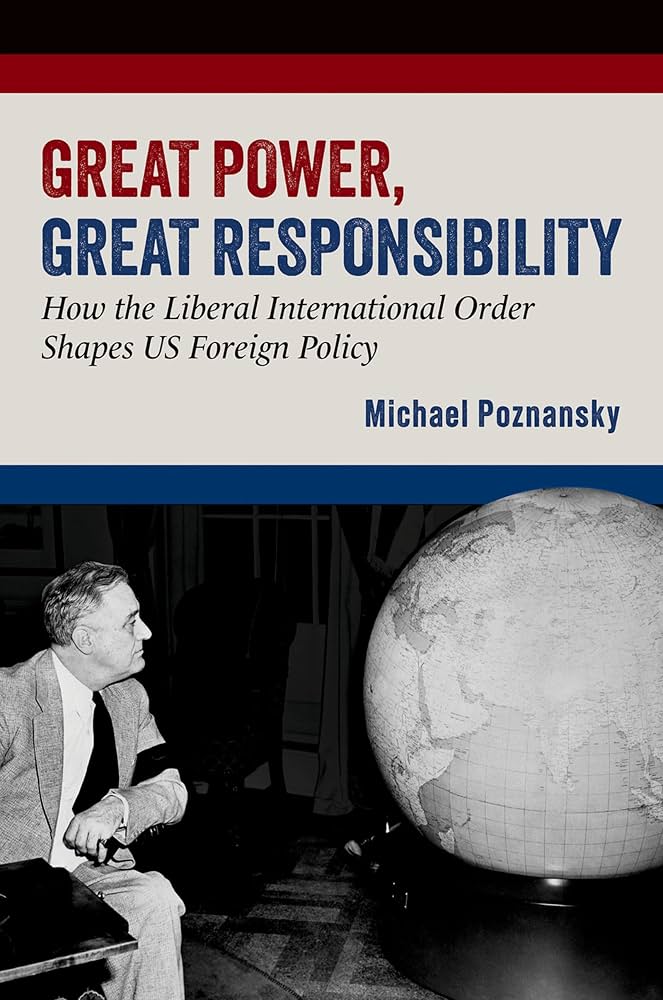
When Do Rules Bind Great Powers?
Great Power, Great Responsibility: How the Liberal International Order Shapes U.S. Foreign Policy, by Michael Poznansky. Oxford University Press, 2025. 272 pages.
Great powers often write rules they later find inconvenient.
Every generation of American policymakers discovers that yesterday’s strategic innovation can become today’s constraint. Alliances create obligations. International law creates procedures. Institutions generate expectations. The difficult question is whether those limits weaken American power or help make it durable.
Michael Poznansky offers a persuasive answer in Great Power, Great Responsibility. He argues that American behavior is shaped by two conditions: the burden of compliance in a particular case and the intensity of competition over the liberal international order itself.
Those conditions produce more than a simple choice between obedience and violation. Poznansky identifies four forms of behavior: convenient compliance, feigned compliance, brittle compliance, and brazen noncompliance. Together, they explain why the United States sometimes follows the rules, sometimes preserves the appearance of fidelity while working around them, and sometimes discards them openly.
This is not an argument that rules control American power. Nor is it a claim that the liberal international order is merely rhetoric concealing national interest. Poznansky instead shows that rules alter the costs of action, the justifications leaders must provide, and the support they can expect from allies and other audiences.
That middle position is what makes the book valuable. Arguments about the liberal international order often begin with a verdict. Either the order constrained the United States and produced an unusually stable system, or it supplied respectable language for the ordinary exercise of great-power dominance. Poznansky asks a better question: If the order sometimes constrained American behavior and sometimes did not, what explains the difference?
The Korean War provides one of the book’s clearest illustrations. Faced with North Korea’s invasion of the South, the Truman administration placed the American response within the framework of the United Nations. That approach imposed diplomatic procedures and institutional constraints, but it also reinforced the legitimacy of the postwar order the United States hoped to lead.
In Poznansky’s account, compliance was not simply an act of legal idealism. When the burden of compliance remained manageable and the intensity of order competition was low, accepting constraints could advance broader American strategic interests. Compliance became an instrument of leadership rather than merely a limitation upon it.
Other combinations of burden and competition produced different forms of behavior. When compliance became costly but policymakers remained sensitive to the risks of open violation, they might engage in feigned compliance, preserving the appearance of fidelity while circumventing the rules. Elsewhere, Poznansky distinguishes this behavior from brittle compliance and brazen noncompliance, completing a typology that reaches beyond the binary choice between obedience and violation.
This typology is the book’s most original contribution. Between faithful compliance and outright defiance lies a much richer range of strategic behavior. Poznansky gives readers a vocabulary for recognizing the difference between a government that finds rules convenient, one that works around them, one whose adherence weakens under pressure, and one prepared to violate them openly.
That distinction matters to military professionals because American strategy is conducted through institutions. Alliances, coalition commitments, basing agreements, legal authorities, intelligence relationships, and diplomatic assurances create obligations that can slow decisions or narrow options. They also help assemble support, distribute risk, and sustain policy after the first phase of a crisis has passed.
A commander or planner working with allies will recognize the tradeoff. Consultation and legal review may complicate action at the outset. They may also make it more likely that partners will still be present six months later.
Rules matter even when they fail to prevent a particular decision. They affect whether allies participate, whether governments provide access, whether coalitions hold together, and whether an operation retains political support as its costs become clearer.
Restraint is not the opposite of power. It is one of the ways power becomes usable.
Poznansky is especially effective at separating structural explanation from judgments about presidential character. Individual leaders matter, but describing one administration as multilateral and another as unilateral cannot explain why the same state behaves differently across cases. His framework instead directs attention to the pressures policymakers face: how difficult compliance would be and how intensely the order itself is being contested.
That analytical discipline also opens an important question. National-security officials do not experience the burden of compliance as an abstract variable. They encounter it through operational timelines, legal review, alliance consultation, planning assumptions, and competing definitions of risk. Poznansky’s framework therefore raises a further question: whether domestic institutions can make restraint more durable precisely when compliance becomes burdensome.
That question has immediate strategic relevance. Renewed great-power competition may make international constraints feel increasingly costly. Yet competition also increases the need for allies, access, intelligence sharing, economic coordination, and confidence in American commitments. The United States may possess the material capacity to act alone while finding that fewer of its objectives can be achieved alone.
An international order cannot endure if its leading power consistently expects compliance from others while treating its own obligations as optional. Repeated violations do more than invite charges of hypocrisy. They make American assurances less credible and future cooperation more difficult to secure.
Great Power, Great Responsibility will reward officers working with allies and partners, military planners, professional military education faculty, and readers interested in grand strategy. Its value lies less in proving that rules always constrain powerful states than in showing the many ways powerful states respond to rules they possess the power to ignore. At a moment when American strategy depends as much on sustaining coalitions as projecting force, Poznansky’s framework offers a disciplined way to understand when rules bind, when they bend, and when they break.
About the Reviewer
Lucas F. Schleusener is Co-Founder and CEO of Out in National Security.


